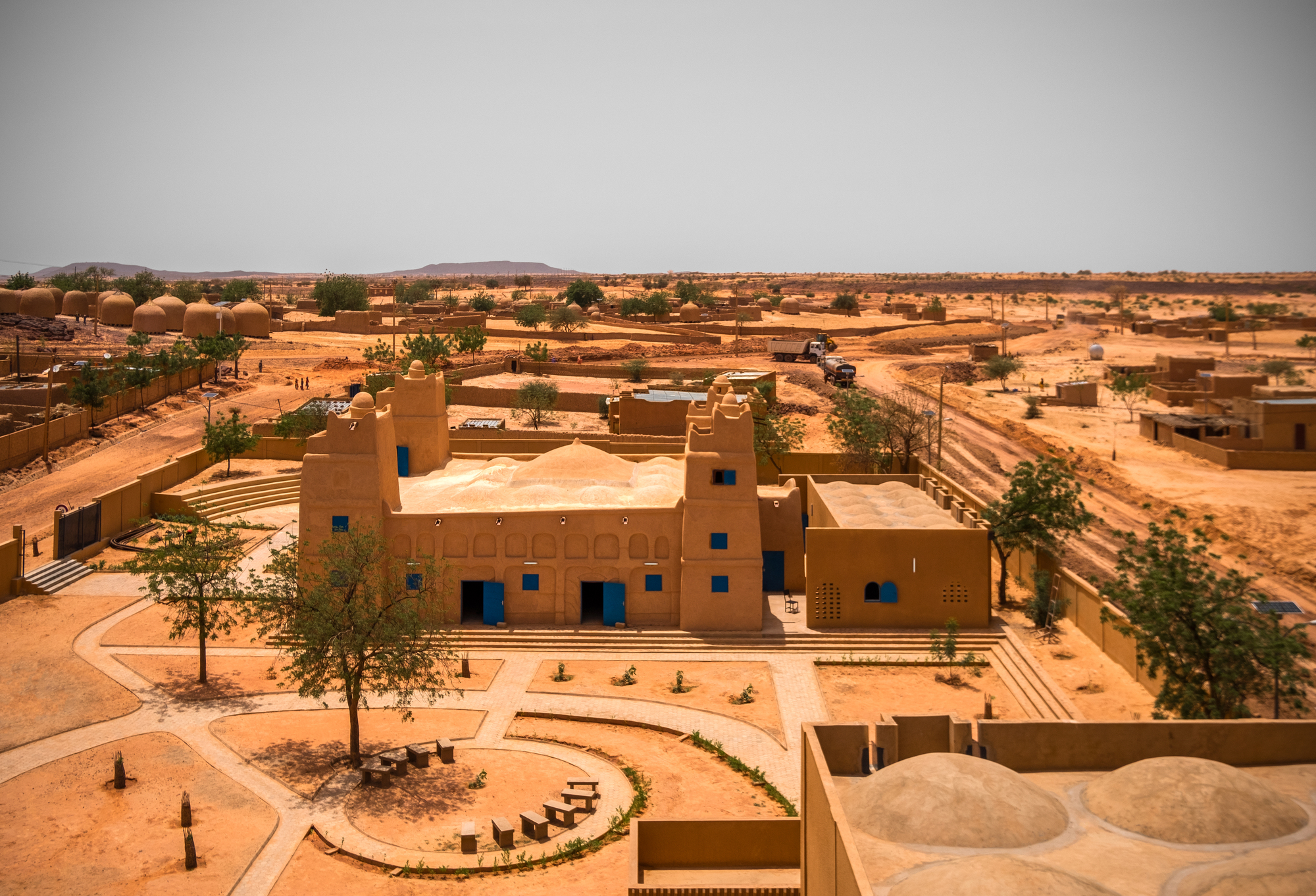
Dandaji is a Sahel settlement that has survived drought by making everything legible. Water is administered by marshals. Births are witnessed and filed. The Hikma complex keeps the records that keep the village alive. Inside this order, two people have learned each other's bodies the way you learn a room you have lived in for years: Zainab, the Hikma's designated successor in training, and Bashir, a junior water marshal. The future is a place they have already agreed to travel to together.
Bashir is chosen for the seasonal pilgrimage, the boundary crossing the marshals undertake to secure the village's water stores. He does not come back with the others. Zainab crosses into the desert to find him. She returns. In Dandaji, this does not happen. When you enter the desert, you do not come back.
Then her pregnancy is discovered. One question moves through Dandaji: who is the father. A name would allow the village to turn the impossible into the manageable. Zainab says nothing. She will not enter a false record into a village built entirely on the integrity of its records. Her life becomes a case. A writ is sealed. Her brother invokes Nasab Seal - an ancient kin declaration that stops the crowd at the compound gate but not the writ. A sealed basket wound in the standard cord is placed in her hands. She is delivered into the desert.
The desert does not behave like a desert. She marks her path and returns to find the marks gone, the sand smooth, as if she was never there. Then she discovers that certain moments hold: the wind stops, the light shifts, and in those windows she can move and the ground keeps her. She learns to read this place the way she was taught to read an unfamiliar ledger, looking for the rule of the surface before she writes inside it.
She encounters others. A man maintaining a boundary marker who reaches for certain words as if he has not needed them in some time. A hyena that comes not for her body but for something she is carrying, circling with the patience of an auditor until she opens her hand and gives it up. And below a ridge, Bashir alive at the edge of a cyan pool, moving with the attention of someone performing a task his body has fully absorbed. She calls his name, but he couldn't hear her. Every attempt to reach him returns her to the ridge. He does not look up.
She follows a lamp glow through the haze to a hut. Inside a woman waits with copper wire in her hands and water measured in a bowl, who looks up the way someone looks up when they have been expecting a delivery. It is Muna, sent into the desert at fifteen, the same age Zainab was when she watched her go. A grown woman now, stationed, time rearranged around her.
Labour begins, long and without ceremony. Afterwards Muna carries the child to the boundary marker, sets it down in the sand, and presses a clay seal fragment into the ground beside it.
Then the first drop falls. Then another. Then the sky opens over a landscape that has not felt rain in years, heavy rain on ochre walls and cracked courtyards and drought-split earth, rain the village will record as confirmation, as covenant, as proof that the system holds.